
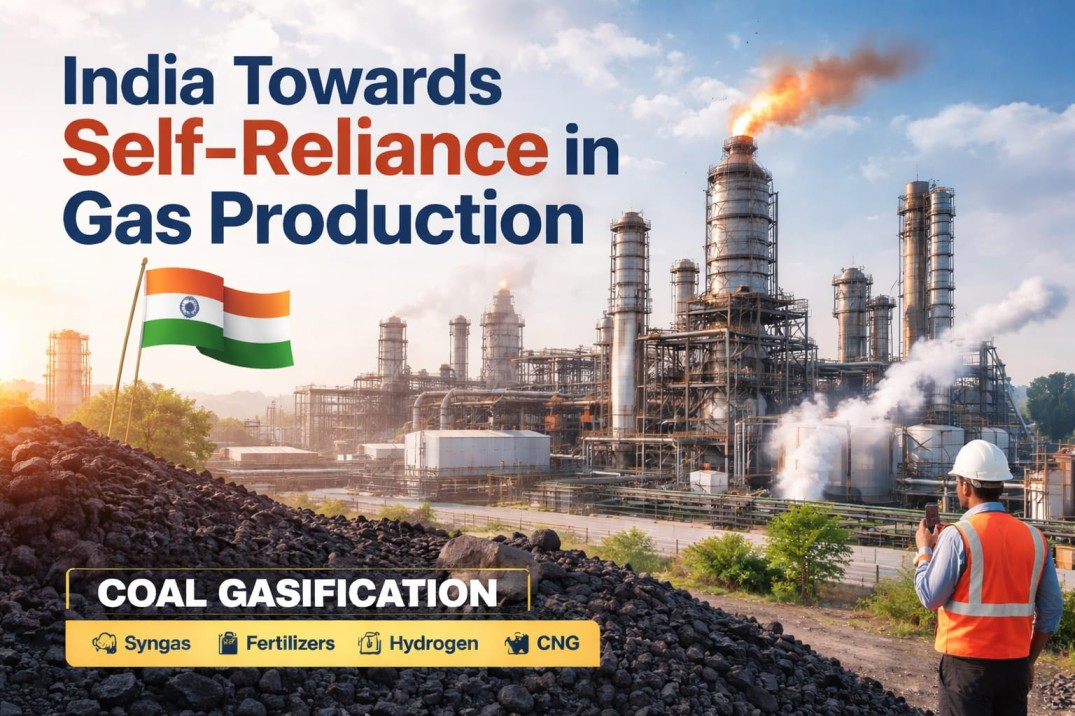
India is moving rapidly toward becoming one of the world’s largest economies. As industries expand, cities grow, and infrastructure projects increase, the country’s demand for energy is rising faster than ever. However, India still depends heavily on imported crude oil, natural gas, and other fuels to meet its growing energy needs.
This dependence creates economic pressure because global fuel prices can fluctuate sharply. It also affects the country’s energy security, especially during international conflicts or supply disruptions. To reduce this dependence and make better use of its vast coal reserves, India is now focusing on coal gasification.
Coal gasification is emerging as a major solution that could help India become more self-reliant in gas production while also supporting industrial growth and cleaner energy alternatives.
What Is Coal Gasification?
Coal gasification is an advanced process in which coal is converted into gas instead of being burned directly. In this process, coal reacts with oxygen and steam under very high temperatures and pressure.
This reaction produces a gas mixture known as synthesis gas, or syngas. Syngas mainly contains carbon monoxide and hydrogen. It can then be cleaned and used for several purposes such as fuel production, power generation, fertilizer manufacturing, chemical production, and even hydrogen fuel.
Unlike traditional coal burning, coal gasification allows better control over emissions and makes coal more useful for multiple industries.
How Does Coal Gasification Work?
The coal gasification process involves several important steps:
- Coal is selected and crushed into smaller pieces.
- The prepared coal is fed into a gasifier.
- Oxygen and steam are added under high pressure and temperature.
- Chemical reactions convert coal into syngas.
- The gas is purified to remove impurities.
- The purified gas is then used for industrial or energy purposes.
This process makes it possible to convert India’s abundant coal reserves into a cleaner and more flexible energy source.
Why Is Coal Gasification Important for India?
India has one of the largest coal reserves in the world. At the same time, the country imports a large amount of crude oil, natural gas, and LNG every year.
Coal gasification offers a way to use domestic coal resources more efficiently and reduce the country’s dependence on expensive imports.
1. Supports Energy Self-Reliance
Energy self-reliance is especially important for a fast-growing economy like India because it helps ensure a stable supply of energy even during global crises.
2. Reduces Import Costs
India spends billions of dollars every year importing oil and gas. By converting domestic coal into syngas and other fuels, the country can significantly reduce its import bill.
Lower import costs can also help reduce pressure on foreign exchange reserves and improve the country’s trade balance.
3. Boosts Industrial Growth
Coal gasification can support several industries including:
- Fertilizer manufacturing
- Petrochemicals
- Methanol production
- Synthetic fuel production
- Steel and cement industries
- Hydrogen production
This means coal gasification can become a key driver of industrial development in India.
4. Helps Create Cleaner Energy Options
Direct coal burning is one of the biggest sources of pollution. Coal gasification, although still based on coal, is considered relatively cleaner because emissions can be captured and controlled more effectively.
It also opens the door for cleaner fuels such as methanol, hydrogen, and synthetic natural gas.
Major Uses of Coal Gasification
Coal gasification is not limited to one industry. The gas produced from coal can be used in several important sectors.
Power Generation
Syngas can be used to generate electricity in power plants. This can help reduce dependence on imported LNG and improve power supply reliability.
Fertilizer Industry
India imports a large amount of natural gas for fertilizer production. Coal gasification can provide an alternative feedstock for making fertilizers such as urea.
Production of Methanol and Ethanol
Methanol can be produced from syngas and used as an industrial chemical or cleaner fuel. It can also support India’s long-term clean fuel strategy.
Hydrogen Fuel Production
Hydrogen is expected to play a major role in the future of clean energy. Coal gasification can be used to produce hydrogen, which can then be used in industries, transport, and power generation.
CNG and PNG Alternatives
Coal gasification can help produce synthetic natural gas, which can be used as a replacement for CNG and PNG in households and vehicles.
Government Plans and Policy Support
The Indian government is actively promoting coal gasification as part of its long-term energy strategy.
Under the Atmanirbhar Bharat mission, the government wants to reduce dependence on imported fuels and make better use of domestic coal resources.
Several policy initiatives have already been introduced:
- Encouraging public and private investment in coal gasification projects
- Promoting coal-to-chemical and coal-to-fuel industries
- Supporting research and development in advanced gasification technologies
- Planning to increase coal gasification capacity by 2030
- Offering incentives to companies investing in gasification plants
Government support is expected to play a crucial role in making coal gasification commercially viable in India.
Benefits of Coal Gasification
Better Environmental Control
Coal gasification makes it easier to capture harmful pollutants before they are released into the atmosphere.
Efficient Use of Coal
Instead of simply burning coal for heat, gasification extracts more value from coal by turning it into multiple useful products.
Employment Opportunities
Large coal gasification projects can create jobs in mining, engineering, manufacturing, plant operations, and logistics.
Multi-Purpose Energy Source
Coal gasification can support electricity, chemicals, fertilizers, transport fuels, and hydrogen production at the same time.
Challenges of Coal Gasification
Although coal gasification has many advantages, there are also some major challenges.
High Initial Investment
Coal gasification plants require advanced technology and large capital investment. Building and maintaining these plants can be expensive.
Technical Complexity
The process is more complex than traditional coal-fired power generation. It requires skilled professionals and advanced infrastructure.
High Water Consumption
Coal gasification uses a large amount of water, which can be a concern in water-scarce regions.
Environmental Risks
Although cleaner than direct coal burning, coal gasification still produces carbon emissions. Proper waste management and carbon capture systems are needed to minimize environmental impact.
The Future of Coal Gasification in India
Coal gasification could become one of the most important pillars of India’s future energy system.
As the country works toward energy security, cleaner fuel options, and industrial growth, coal gasification can help bridge the gap between traditional fossil fuels and future green energy solutions.
It can also support:
- Green hydrogen production
- Expansion of domestic manufacturing
- Cleaner transportation fuels
- Stronger industrial supply chains
- Reduced dependence on imported LNG and crude oil
India’s large coal reserves give it a unique advantage. If the country invests in the right technology, infrastructure, and environmental safeguards, coal gasification can play a major role in transforming the energy sector.
Conclusion
Coal gasification has the potential to become a game-changing technology for India. It can help the country reduce its dependence on imported oil and gas, improve energy security, support industrial growth, and create new employment opportunities.
While challenges such as high costs, water use, and environmental concerns remain, the long-term benefits could be significant.
With strong government support, private sector investment, and continued technological development, coal gasification could help India move closer to becoming self-reliant in gas production and emerge as a stronger player in the global energy market.