
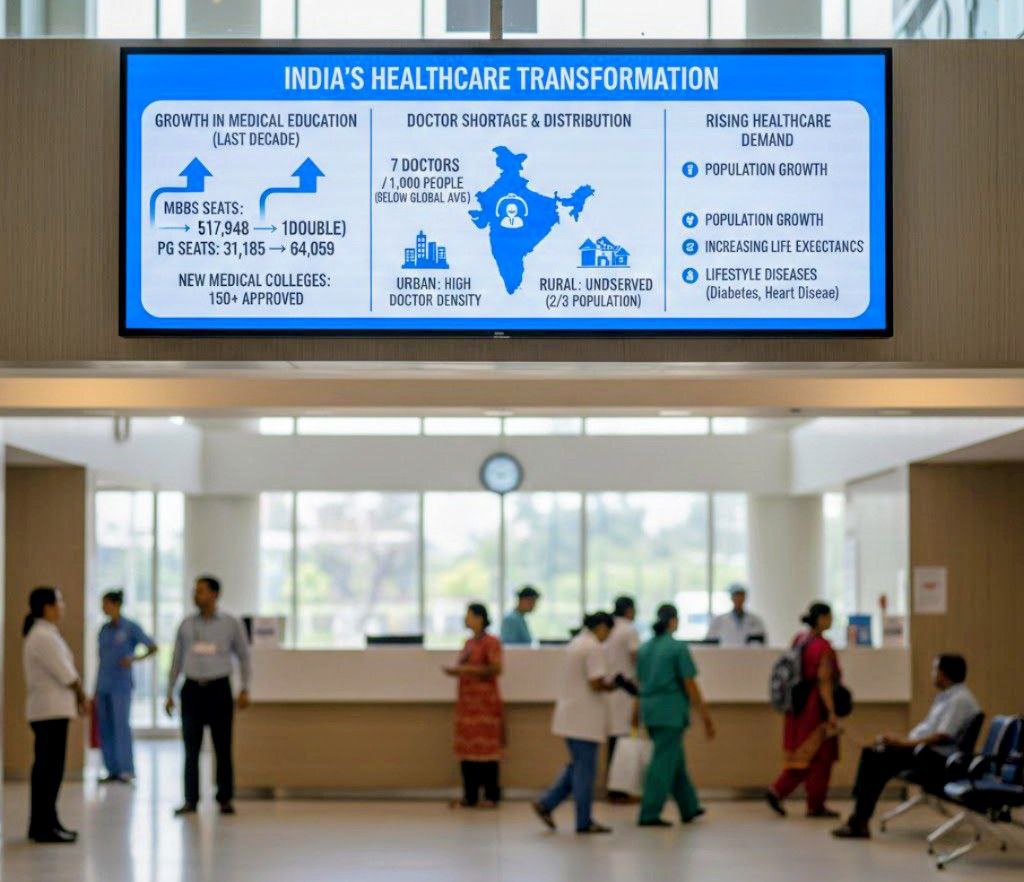
India’s rapid expansion of medical education over the past decade represents one of the most significant public health transformations in the country’s modern history. The approval of more than 150 new medical colleges, along with a sharp rise in MBBS and postgraduate (PG) seats, reflects a strong national commitment to strengthening healthcare capacity.
However, this progress should be viewed not as the final milestone, but as the foundation of a long-term journey toward universal, equitable, and high-quality healthcare for more than 1.4 billion citizens. Expanding the number of trained doctors and specialists is not just an educational reform—it is a strategic investment in public health, economic growth, and social stability.
India’s Doctor Shortage: A Structural Reality
Despite major improvements, India continues to face a structural shortage of doctors. Estimates suggest the country has roughly 7 doctors per 10,000 people, which remains below global public-health recommendations.
The challenge is not only about numbers—it is also about uneven distribution. Urban centers attract most specialists because of better hospitals, infrastructure, salaries, and career opportunities. Meanwhile, rural and remote regions—where nearly two-thirds of India’s population lives—remain underserved.
Bridging this urban-rural healthcare gap is essential if India aims to achieve universal healthcare coverage and emerge as a global healthcare leader.
Why Expanding Medical Education Is Complex
Unlike sectors such as engineering or management education, medical education cannot expand rapidly without strict safeguards.
Training a doctor requires:
- Experienced faculty and mentors
- Functional teaching hospitals with adequate patient load
- Modern laboratories and diagnostic equipment
- Strong clinical exposure and supervision
Any compromise in these areas directly affects patient safety and quality of care. Therefore, increasing seat capacity must always go hand-in-hand with rigorous quality control and transparent regulation.
Key Achievements in the Last Decade
Over the past ten years, India has made measurable progress:
- MBBS seats have more than doubled
- Postgraduate medical seats have risen significantly
- 150+ new medical colleges have been approved
- Government medical colleges expanded into underserved districts
- District hospitals strengthened through academic integration
These reforms indicate a shift from limited capacity toward a large-scale, self-sustaining healthcare workforce ecosystem that includes doctors, specialists, educators, and researchers.
Rising Pressures on the Healthcare System
Even with increased training capacity, demand for healthcare is growing faster than supply due to:
- Rapid population growth
- Increasing life expectancy
- Ageing demographics
- Rising lifestyle diseases such as diabetes, heart disease, and cancer
- Greater public awareness and expectations from healthcare services
Without continuous expansion and modernization, current progress may fall short of future healthcare needs.
A Three-Pronged Strategy for Sustainable Growth
To maintain momentum while protecting quality, India must focus on a balanced strategy:
1. Modernize Existing Medical Colleges
Upgrading older institutions with digital classrooms, simulation labs, advanced diagnostics, and research infrastructure is more cost-effective than building entirely new campuses and can quickly improve training quality.
2. Expand Seats Where Infrastructure Already Exists
Increasing intake in well-performing colleges that already have adequate faculty, hospital beds, and patient flow can rapidly boost doctor availability without compromising standards.
3. Build New Colleges in Underserved Regions
Strategically establishing medical colleges in rural and aspirational districts will promote regional equity, reduce migration toward metropolitan hospitals, and strengthen grassroots healthcare delivery.
The Global Opportunity: Medical Tourism and Research Leadership
India is steadily emerging as a destination for affordable, high-quality medical treatment, attracting international patients across specialties such as cardiac surgery, oncology, orthopedics, and organ transplantation.
But long-term global competitiveness depends on more than infrastructure. It requires:
- Highly trained super-specialists
- Strong medical research output
- International accreditation and safety standards
- Continuous professional education
- Ethical, transparent healthcare delivery
Investing in excellence alongside expansion will determine whether India becomes a true global healthcare powerhouse.
Critical Gaps That Still Need Attention
Faculty Shortage
Rapid seat expansion has created a growing need for qualified professors, researchers, and clinical mentors. Faculty development programs, research incentives, and better academic career pathways are essential.
Rural Doctor Retention
Producing more doctors alone will not solve rural shortages. Effective retention requires:
- Competitive salaries
- Quality housing and infrastructure
- Career advancement opportunities
- Telemedicine and specialist support
- Safe working environments
Digital Health Integration
Technologies such as telemedicine, AI-assisted diagnostics, and electronic health records can dramatically expand healthcare reach. Medical curricula must evolve to include digital and data-driven healthcare training.
Research and Innovation
To move from service provider to global medical innovator, India must:
- Increase research funding
- Encourage clinical trials
- Support biotech and medical technology startups
- Strengthen academic-industry collaboration
Balancing Quantity with Quality
India’s expansion of medical education is a historic opportunity—but growth alone is not enough. Sustainable success depends on:
- Strong quality assurance systems
- Transparent and accountable regulation
- Equitable regional distribution of doctors
- Continuous monitoring and evaluation
- Long-term healthcare workforce planning
Healthcare is not merely a sector—it is the foundation of national productivity, social equity, and global competitiveness.
Conclusion
India has taken bold and necessary steps to expand its medical education ecosystem. The surge in medical colleges and training seats demonstrates clear strategic intent and political commitment.
Yet, given the country’s vast population, changing disease patterns, and rising healthcare expectations, sustained and carefully managed expansion remains essential.
The real challenge now is to ensure that growth is responsible, equitable, and future-ready. If India successfully aligns scale with excellence, it will not only meet domestic healthcare needs but also emerge as a global leader in medicine, research, and affordable healthcare delivery.